Secret entrance to the hunting trophy chamber
Ponniyin SelvanThe Secret entrance to the hunting trophy chamber is a concealed opening between a palace room and the adjoining hunting trophy chamber. In a story shaped by uncertain appearances and unexplained disappearances, it is both a practical route and the means by which the young woman tries to test what she has seen. Yet her investigation does not settle the mystery: the opening exposes how little she can verify about who has entered, who has left, or whether the events she recounts happened as she remembers them.
Location and Concealment
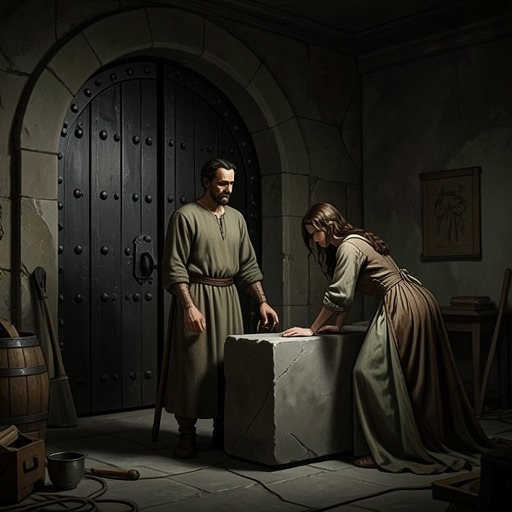
The opening leads from the young woman’s room into the hunting trophy chamber next door. On the previous day, a mirror had been placed in front of it. That detail supplies the immediate cause of her suspicion: when she feels that someone may be approaching her from behind, she looks at the mirror and finds no one reflected there, but remembers that someone could be watching from behind it, inside the adjoining chamber. The mirror conceals the entrance while also making it possible for her to imagine an unseen observer just beyond it.
Her first response is not to assume that an intruder is present. She tries to dismiss the possibility because she sees no reason anyone should be inside the palace, but her doubts persist. She opens the entrance and steps through to inspect the chamber. The concealed route therefore becomes a test of competing explanations: she can investigate the space directly, but what she finds does not establish whether anyone had been hiding there before she arrived.
Investigation and Conflicting Accounts
The chamber contains Idumbankaari, a palace servant who is cleaning. Asked whether anyone else has come by, he firmly denies it. His presence gives the young woman an ordinary explanation for why the room is occupied, but it does not reassure her: she still thinks someone else may be hidden there. Rather than press the matter, she returns to her room and waits to see whether whatever is happening will reveal itself.
She then hears what she takes to be confused movement and voices in the hunting trophy chamber, followed by crashing noises. As the door shifts, a figure opens a small, round opening in it and tries to get through, calling for help. The young woman believes the figure resembles Vallavarayan Vandhiyathevan and pulls him into her room. The entrance and the adjoining door thus become part of a hurried passage between hiding and apparent rescue. But even at this point she does not know who else is in the chamber, or whether Idumbankaari is involved in what she suspects may be a plot against Vallavarayan Vandhiyathevan.
She decides to investigate the people she has heard rather than tell her father that Vallavarayan Vandhiyathevan is in her room. Her stated concern is that discovery of his presence could put his life in danger. She leaves him where he is and goes back through the entrance. There she sees five or six men standing in different parts of the chamber. Before she can question them, her companion Chandramathi comes in through another door. Afraid that Chandramathi may discover Vallavarayan Vandhiyathevan and raise an alarm, the young woman turns back to her room and brings her companion inside.
Disappearance and Uncertainty
When the young woman looks again, Vallavarayan Vandhiyathevan has vanished. She asks Chandramathi whether she saw anyone, but Chandramathi denies seeing anybody. The young woman returns to the hunting trophy chamber and finds that the five or six men have vanished as well. Idumbankaari insists that no men were ever there. The concealed opening has allowed her to move between the room and the chamber, but it has not given her reliable knowledge of what took place in either one.
This sequence makes the entrance an instrument of inquiry that repeatedly fails to deliver certainty. The young woman first searches the chamber for a watcher, then uses the route to follow sounds, locate apparent strangers, and return to check on Vallavarayan Vandhiyathevan. Each crossing seems to promise a clearer account; each return instead brings another denial or disappearance. Chandramathi’s suggestion that the young woman may be imagining the men gives the episode a possible explanation, but does not resolve it. The young woman herself remains unsure whether events were real, dreamed, or a hallucination.
A Route That May Not Be Secret
After hearing the account, Pazhuvoor Ilaiya Rani asks whether another secret way leads out of the room. The young woman says she knows of none. Pazhuvoor Ilaiya Rani proposes that Vallavarayan Vandhiyathevan might have left the same way as the young woman and Chandramathi, but the young woman considers that impossible: a dozen maids were in the passages, and his departure would have been noticed. The exchange turns attention from the entrance’s existence to its limits. It connects two rooms, but the account supplies no confirmed explanation for how Vallavarayan Vandhiyathevan disappeared or escaped notice.
The young woman also fears that the supposed secrecy of the passage may be compromised. While Vallavarayan Vandhiyathevan is in her room, she worries that the route may not be secret after all and that its occupants could be exposed. The entrance therefore changes from a concealed convenience into a source of vulnerability: it enables access, but also makes the boundary between private room and adjoining chamber uncertain. Because the episode ends with questions rather than a verified account of who used the route, the opening remains a physical feature around which suspicion gathers, not a solution to the mystery.